Count the indigenous peoples of the European Union and you will find a single group. The Sámi live across the north of Norway, Sweden and Finland and along the Kola Peninsula in Russia. Estimates put them at between 75,000 and 100,000: roughly half in Norway, most of the rest in Sweden, smaller numbers in Finland, and around 2,000 on the Russian side. The estimates vary that widely because no official census of Sámi has ever been taken in any of the four countries.
Indigenous is a legal category rather than a claim about who arrived first. The convention that defines it asks for two things: descent from the people who were there before the present state borders were drawn, and the survival of some or all of their own social, economic, cultural and political institutions. Self-identification counts as a fundamental criterion. On that test it does not matter who reached Lapland in which millennium. What matters is that the Sámi had their own institutions when the first border was cut through their land in 1751, and still have them. Where the edges of the category lie is a live question: a Finnish law setting out who may vote for the Sámi Parliament failed in 2022 and passed only in 2025.
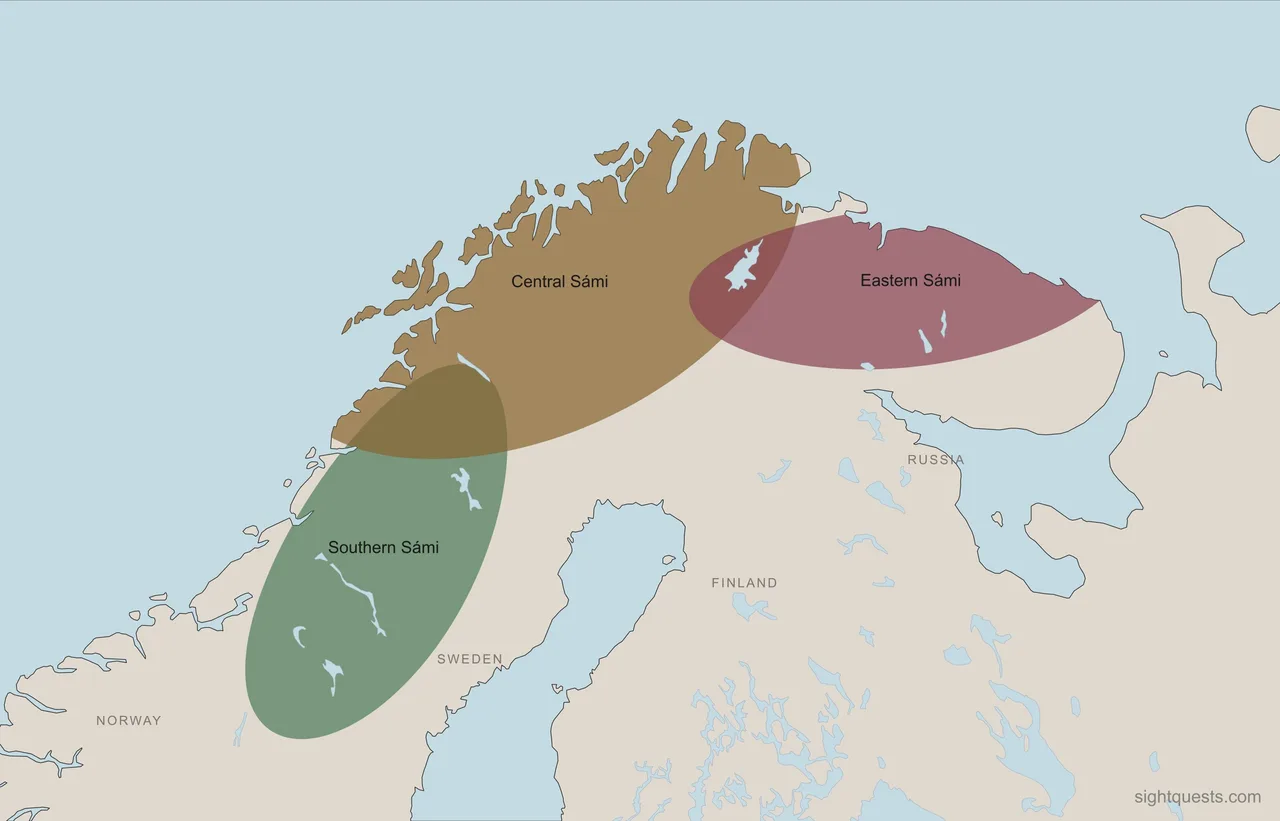
The three Sámi language groups and where they are spoken today, across Norway, Sweden, Finland and Russia. Historical extents shifted continuously and are contested, which is why this shows the present day. Language grouping after Peschel (2021), extents indicative; coastline from Natural Earth.
Where did the Sámi languages come from?
The Sámi languages are not related to Norwegian or Swedish. Their relatives are Finnish, Estonian, Hungarian, and a scatter of languages along the Ob and the Yenisei, all of them Uralic. That family spread west from somewhere around the Urals, or from beyond them, roughly four thousand years ago, during a period when an abrupt climate shift made life harder for herders than for people who lived off rivers and lakes.
The same movement shows up in DNA. A Siberian component entered the northern European gene pool at least 3,500 years ago, and the Y-chromosome haplogroup that came with it, N1c, is now the main male lineage across north-eastern Europe. More than half of eastern Finnish men carry it.
The north itself was settled long before any of that, from the end of the last ice age about ten thousand years ago, and that figure is where most short accounts of Sámi history begin. The language arrived much later. Proto-Sámi seems to have formed in the lake country of southern Finland and Karelia and to have moved north into Lapland between about 300 and 800 AD. At Levänluhta in western Finland, a lake burial used around fifteen hundred years ago, the ancient DNA came out closest to Sámi speakers, who now live several hundred kilometres further north in Finnmark, Norrbotten, Lapland and on the Kola Peninsula.
Something of what was spoken there before them may survive in the vocabulary. Several hundred words in the Sámi languages have no counterpart in any related language and no known origin, and almost all of them describe the land: snow crust, spring water, weather, terrain. The usual reading is that they were taken from the languages of the north before Sámi arrived. Those languages left nothing else, so the reading rests on the words themselves and cannot be checked against anything.
How one language became several
Nine Sámi languages are still spoken across the four countries. Northern Sámi is much the largest, with around 26,000 speakers in Norway, Sweden and Finland. Southern, Ume, Pite and Lule Sámi run down the Norwegian and Swedish side, some of them held by only a few hundred people. Inari Sámi is spoken around one lake in Finland and nowhere else, by about 400. Skolt Sámi has a few hundred. Kildin and Ter Sámi sit on the Russian side, where Ter was down to roughly two speakers by 2011 and Akkala Sámi has counted as extinct since its last fluent speaker died in 2003.
Variety | Group | Speakers |
|---|---|---|
Southern Sámi | Southern | ~600 |
Ume Sámi | Southern | ~20 |
Gävle Sámi | Southern | extinct, 19th century |
Northern Sámi | Central | ~26,000 |
Lule Sámi | Central | 1,000–2,000 |
Pite Sámi | Central | ~20 |
Inari Sámi | Eastern | ~400 |
Skolt Sámi | Eastern | ~320 |
Kildin Sámi | Eastern | 150–350, census 2010–2020 |
Ter Sámi | Eastern | 2 in 2011, and possibly none now |
Akkala Sámi | Eastern | extinct, last speaker died December 2003 |
Kemi Sámi | Eastern | extinct, 19th century |
The Sámi languages and how many people still speak them. Nine are still spoken and three are not. Northern Sámi has more speakers than the other eight living varieties together; Ter Sámi, at the other end, had two speakers in 2011 and may now have none. Counts are a patchwork and vary by source and by year: the Finnish figures come from the Sámi Parliament of Finland, the Russian ones from the 2010 and 2020 censuses, and the rest from the reference literature on each language. How many Sámi languages there are is itself disputed: Kainuu Sámi is not separated from Kemi here, and Gävle Sámi rests on a recent proposal. Classification after Sammallahti (1998), grouping after Peschel (2021).
Distance did most of the splitting. Sápmi runs some 1,500 kilometres end to end, and Proto-Sámi covered that ground quickly, through small mobile groups with no writing, no capital and no authority able to hold a standard in place. A change that started in one place travelled as far as people stayed in contact and no further. Neighbouring languages still have a great deal in common. The differences pile up with distance, and across the two ends of the chain they are too large to bridge. Each language then spent centuries pressed against a different neighbour, which left its own loanwords and eventually its own alphabet. Skolt Sámi had no written form until the 1970s. Kildin Sámi is written in Cyrillic.
What the languages hold is not the same from one to the next, and joik shows it best. Joik is the Sámi song tradition, sung unaccompanied, built from short phrases that circle rather than resolve, and in its oldest form carrying no fixed words at all. In Northern Sámi the verb juoigat takes a direct object.
A joik is not sung about a person, an animal or a place. It is sung of them, the way a painter does not paint about a flower.
The northern luohti is often almost wordless. The eastern leu'dd, the Skolt Sámi form, runs to long narrative texts and sits closer to storytelling. Missionaries treated the whole practice as pagan and it was pushed out of churches and schools. It returned in the 1960s and 1970s and is now recorded, staged and folded into pop music.
Reindeer were once used to hunt reindeer
Sámi are pictured, above all, as reindeer herders. Large-scale herding is younger than it looks. For most of the period archaeology can see, Sámi economies ran on hunting wild reindeer, fishing and trapping. The hunting survives in the ground as pitfall systems, lines of dug traps at river crossings and along migration routes, some running to hundreds of pits, in use across prehistory with peaks in the Iron Age and the early medieval centuries.
Tame reindeer existed alongside the hunt, in small numbers, for specific jobs. A family in the mid-sixteenth century might keep ten to twenty animals. They pulled sledges, carried loads, were milked in summer, and were staked out as decoys to draw wild reindeer within range of a bow. Tame animals were part of the hunting equipment.
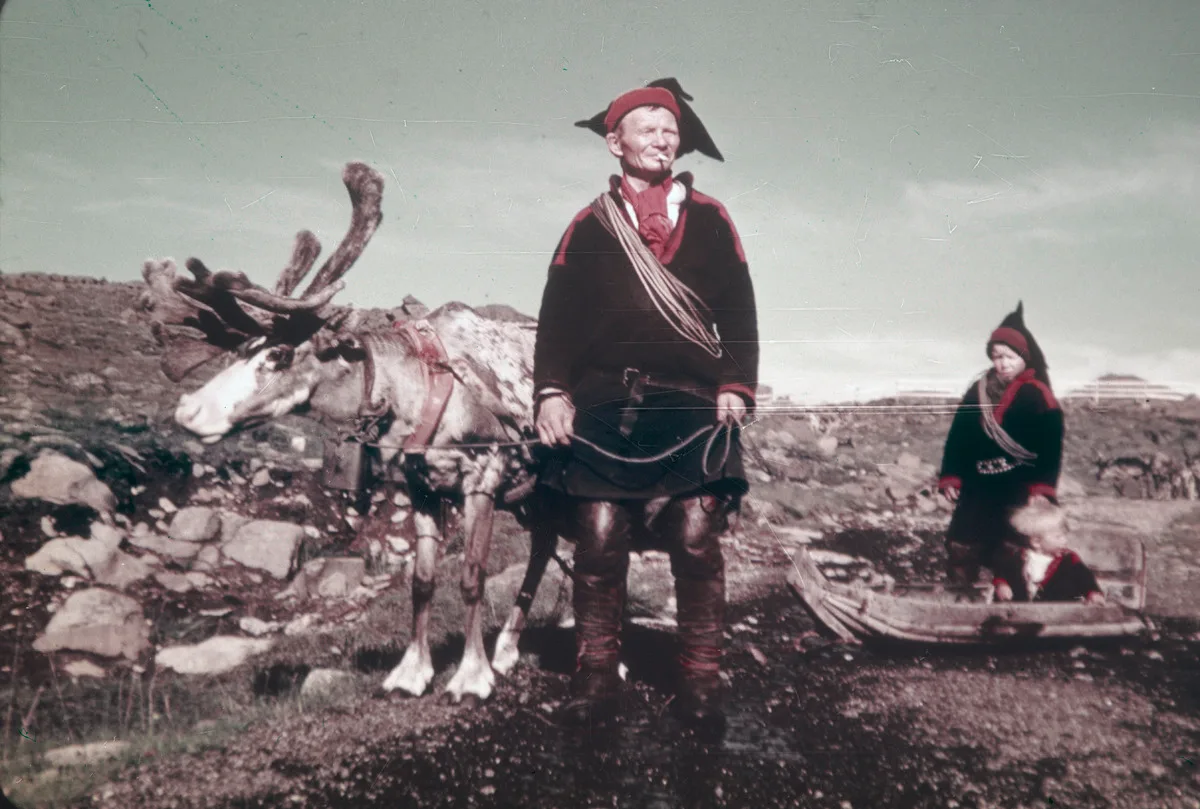
A reindeer in harness with children in a pulkka, 1940. Tame animals were kept in small numbers for specific jobs long before herds were kept for meat: they pulled sledges, carried loads, were milked in summer, and were staked out as decoys to draw wild reindeer within range. A colour transparency on 35 mm film. Photographer unrecorded, 1940. Museovirasto. CC BY 4.0.
Large herds came in the sixteenth and seventeenth centuries, under pressure from outside the north. European demand for fur pulled trade goods up into Lapland, populations grew past what hunting could carry, and the crowns of Sweden and Denmark-Norway raised taxes payable in kind. The animals changed with the economy: reindeer lineages in northern Finland were replaced between roughly 1400 and 1600 by stock whose maternal line came from Siberia. Milking continued until the 1940s, when herding reorganised around meat.
The year that herding produced also shaped the community. A siida was a group of families with recognised territory who moved together between fixed places: fishing waters through spring and summer, hunting and grazing grounds in autumn, and a shared winter village where decisions were taken in common. It was a working unit rather than a tribe, and the word is still in use. The museum in Inari is called Siida. The Skolt Sámi still elect a Siida Council. In 1898, while Finland was a grand duchy of the Russian empire, the siida was replaced as an administrative unit by herding districts called paliskunnat.
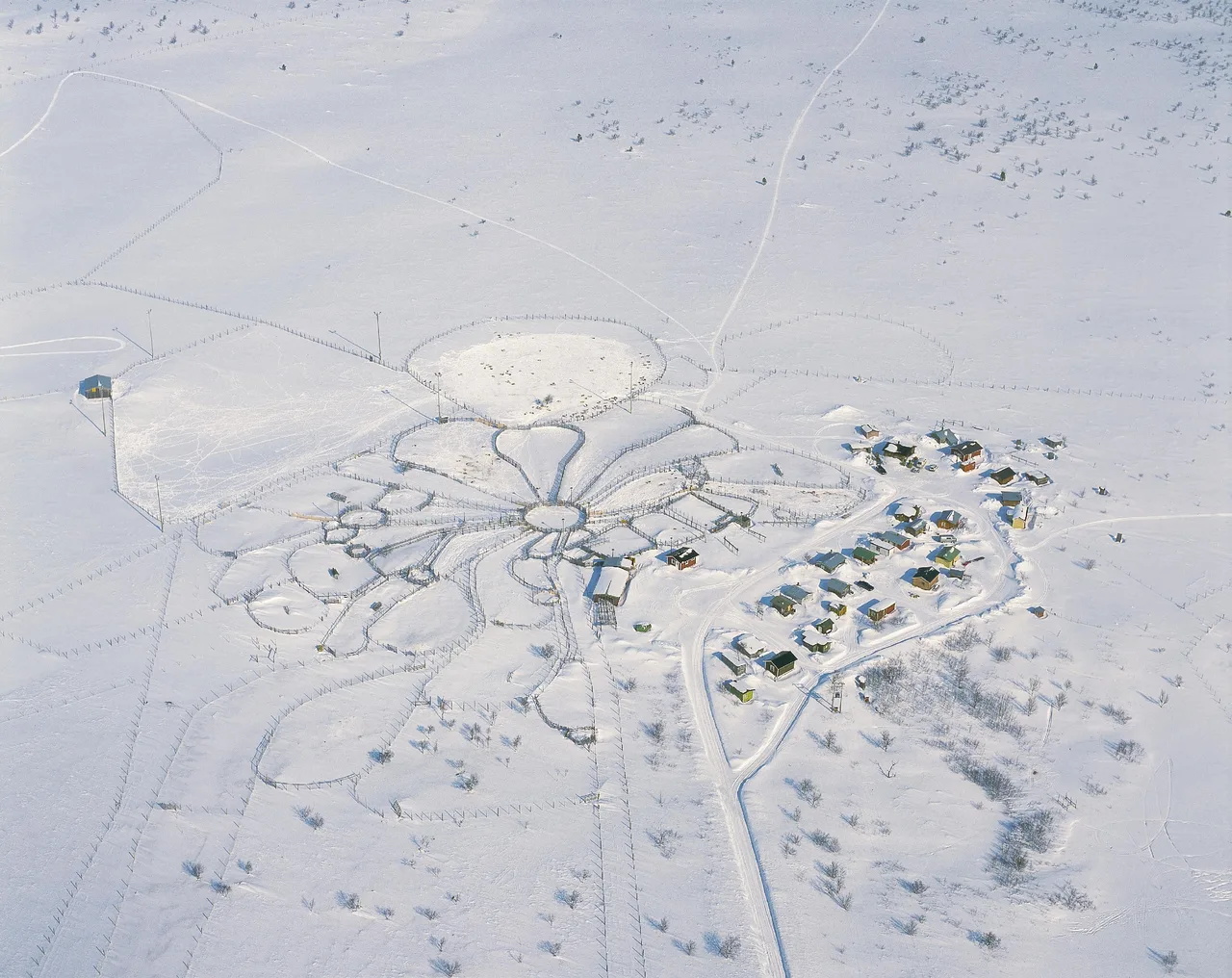
The separation site at Ailigas in Utsjoki, from the air in 1999. Several times a year the herd is gathered off open ground and worked through a corral system like this one. The long fences gather animals over kilometres, the round pen holds the gathered herd, and the small pens radiating off it are one per owner. Calves are marked here with their owner's ear cut, animals are sorted between owners, and some are separated for slaughter. Lentokuva Vallas Oy, 1999. Museovirasto. CC BY 4.0.
Those districts still run herding in Finland, and they work differently from anything across the border. In Norway and Sweden, herding is with few exceptions a right reserved to Sámi. In Finland any EU citizen living permanently inside a herding district may own reindeer if the district accepts them as a member, and since districts vote by majority, Sámi herders can be outvoted where their families have worked for generations. The herding area covers about a third of Finland. Calves are still marked in the summer corrals with a knife, each herder's ear pattern unique to them.
A people divided between four countries
When Denmark-Norway and Sweden fixed their northern border in 1751, Finland was part of Sweden and Norway was part of Denmark, so two kingdoms drew a line straight through Sámi land. They also attached thirty paragraphs to the treaty dealing with the people who lived across it. The Lapp Codicil recognised the Sámi as a people, set out how their nationality and taxes would be handled, guaranteed the right to cross the new border with their herds, and declared them neutral in any war between the two kingdoms. It is still called the Magna Carta of the Sámi.
Then it came apart. Finland passed from Sweden to Russia in 1809 and the codicil lost its force along what was now the Finnish-Norwegian border. In 1852 that border closed to reindeer, cutting herders in Norway off from the Finnish forests where they wintered. In 1889 the Finnish-Swedish border closed as well. Treaties in 1919 and 1972 capped how many Swedish reindeer could cross into Norway. Each of these was an administrative decision taken far to the south, and each one removed a season from a route that only worked in full. A herd that cannot reach its winter forest cannot be kept at its old size.
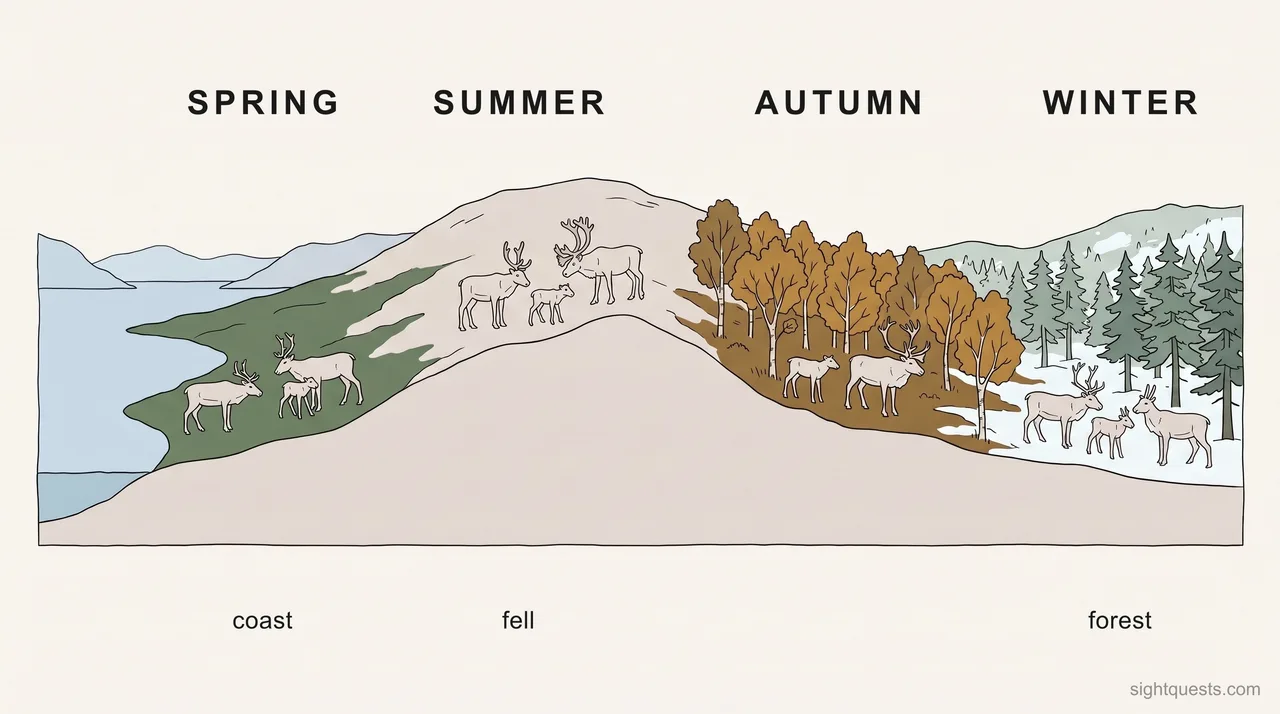
The annual reindeer migration: the coast in spring for calving, the open fell in summer, the birch forest in autumn, and the pine forest in winter, where the animals dig through snow for lichen. The drawing is schematic and shows no particular place. lllustration generated with AI.
The last of these moves came in 1944, when Finland ceded Petsamo to the Soviet Union and about five hundred Skolt Sámi left along with everyone else in the province. Over five years the state resettled them around Lake Inari and built houses, a school and a health station; Sevettijärvi grew from a handful of families to more than fifty. It also ended the Skolt siida's year. Families had spent spring and summer apart at their own fishing waters and wintered together in one village where the prayer house stood. After the resettlement they lived in the same house in every season.
Why are there so few Sámi speakers today?
Norway put its assimilation policy in writing. Language directives from 1880, tightened in 1898, pushed Sámi out of the classroom. Fifty boarding schools went up in Finnmark between 1905 and 1940, where children lived away from their parents and Sámi and Finnish were forbidden. The Land Sales Act of 1902 allowed land in Finnmark to be sold only to Norwegian citizens who could speak, read and write Norwegian and used it daily, and it stayed in force until 1965. Sweden worked from a doctrine summed up in the phrase that a Lapp should remain a Lapp, and schooled Sámi children separately on the strength of it.
Finland wrote none of it down, which supported a comfortable story about a gentler north for a long time. Sámi children went to Finnish-language boarding schools hundreds of kilometres from home, where using their own language was punished. The commission that spent four years gathering those accounts concluded that the absence of a law made little difference to the result. One account describes a child being hit at school in the early 1950s until he spoke Finnish.
Some of that has been repaired. Teaching in Sámi began in Utsjoki and Inari in the mid-1970s, and children in the Sámi Homeland now have a legal right to most of their primary education in Northern, Inari or Skolt Sámi. Sámi allaskuvla in Kautokeino, in Norway, is the only university in the Nordic countries that works in Sámi. The scale is the problem: 778 pupils in the whole of Finland studied a Sámi language in 2023, and around half of all Sámi live outside the areas where the right to it applies.
The schools were not the only removal. Between the 1830s and the 1990s travellers, researchers and officials assembled some 2,200 Sámi items for the National Museum of Finland, much of it gathered in the belief that what was being gathered would shortly be gone. Over the same period Sámi graves in the north were opened and the skulls sent south to anatomical collections at the University of Helsinki.
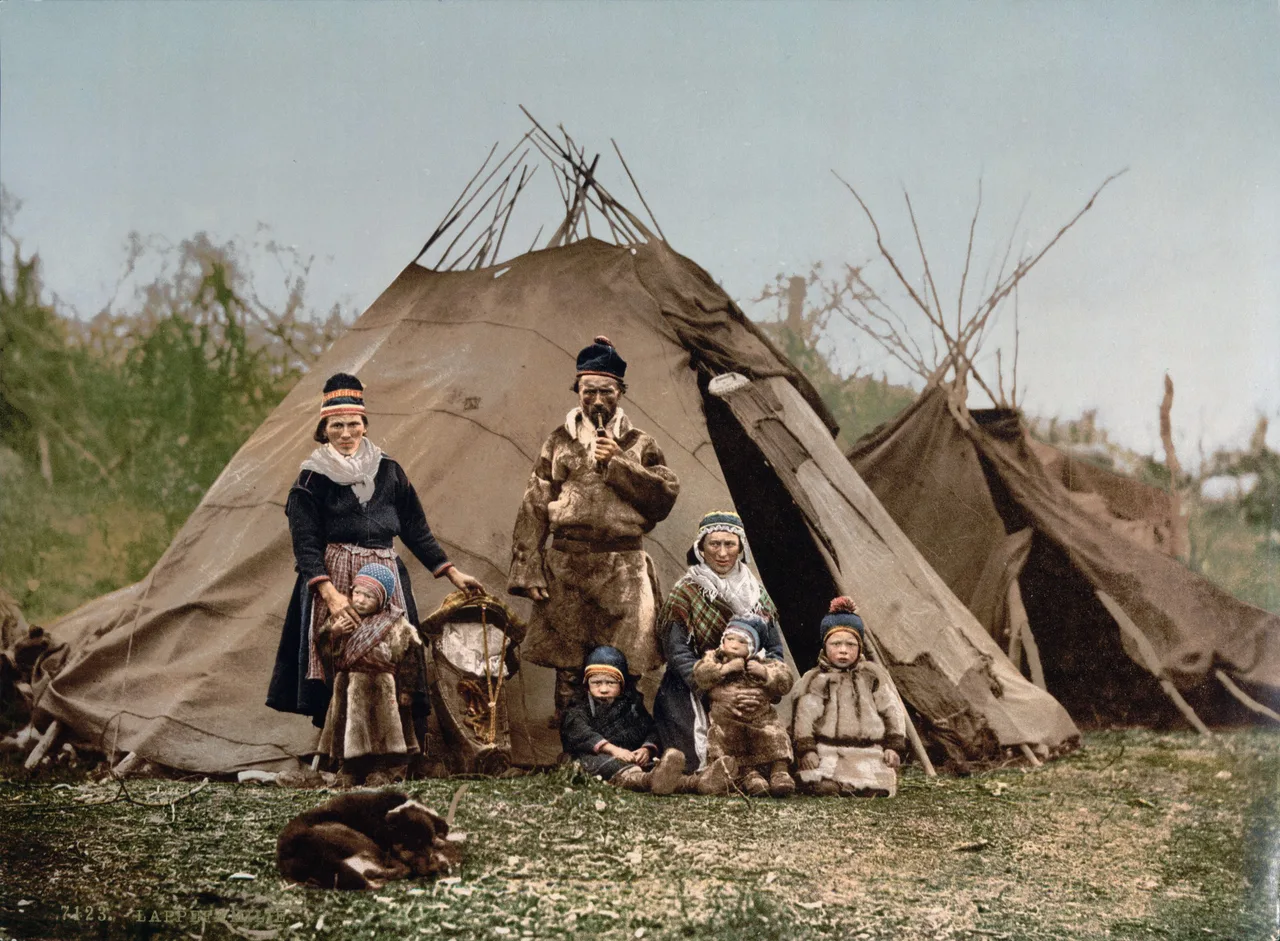
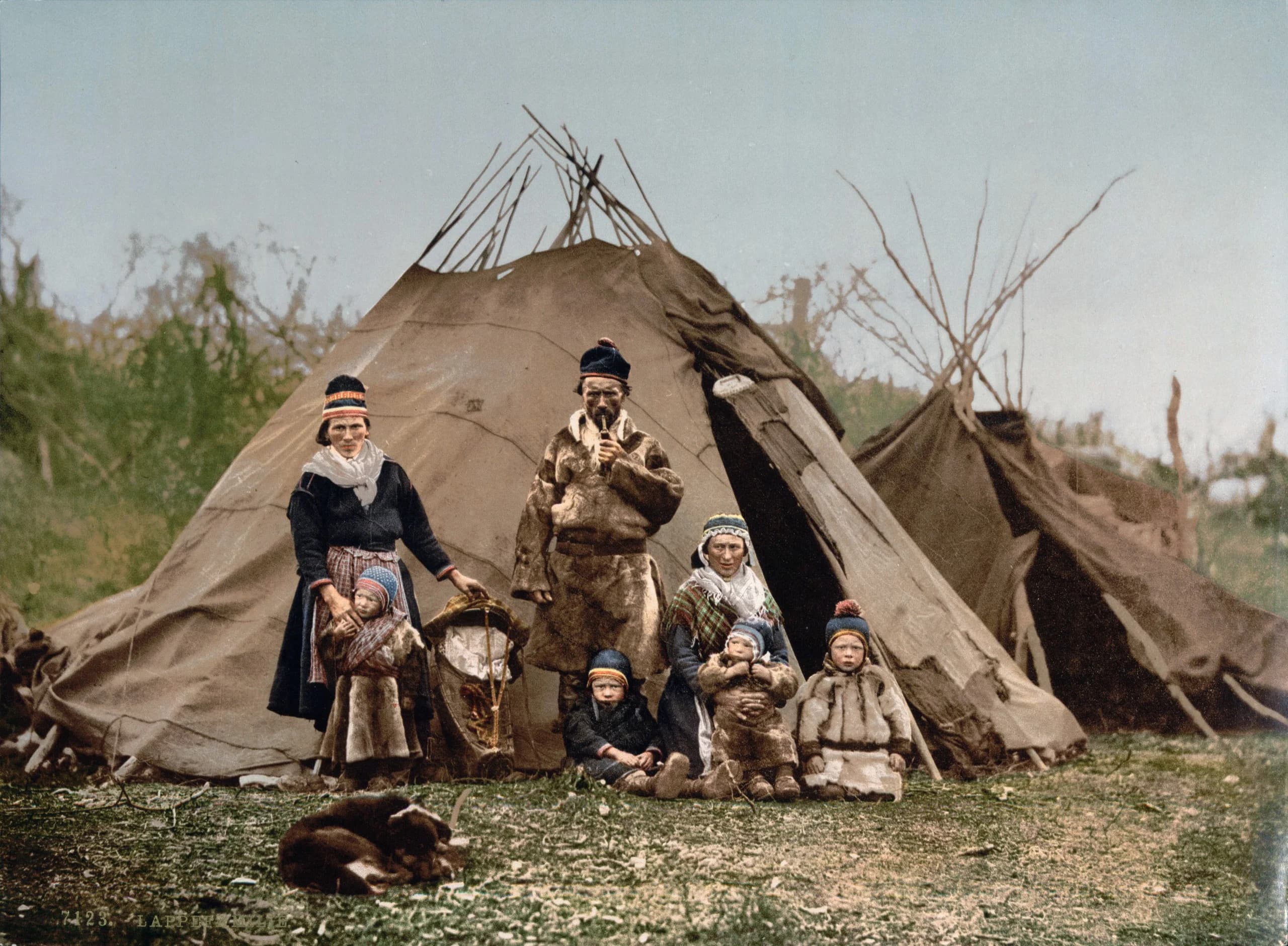
A photochrom sold as a travel view, printed between 1890 and 1905. The colour was added afterwards by a printer, so the colours of the clothing might not match the actual colours. Photographer unrecorded, between 1890 and 1905. Library of Congress, Photochrom Print Collection.
What the Alta protests changed
In 1968 Norway published plans to dam the Alta-Kautokeino river. The scheme would have flooded the Sámi village of Máze, cut reindeer migration routes and damaged one of the great salmon rivers. Objections went through the proper channels for a decade and were dismissed.
In October 1979 seven Sámi activists pitched a lávvu on the lawn outside the parliament in Oslo, three thousand kilometres from the river, and began a hunger strike. Construction restarted in January 1981 and more than a thousand people chained themselves to the site at Stilla; the government sent around a tenth of the entire Norwegian police force and housed them on a chartered cruise ship. On 6 February 1981 fifteen Sámi women occupied the prime minister's office and stayed eighteen hours, until police carried them out.
The dam was built and generates power today. Norway's policy toward the Sámi did not survive the decade. A Sámi Rights Committee was appointed in 1980, the Sámi Act passed in 1987, and the Norwegian Sámi Parliament opened in 1989. Norway ratified the ILO convention on indigenous peoples in 1990, the first country in the world to do so. Sweden's parliament followed in 1993. Finland's, in an earlier form since 1973, sits in Inari in a building called Sajos. Finland has still not ratified the convention, and its truth and reconciliation commission recommended in December 2025 that it should, in a report of some 700 pages and roughly seventy proposals. The prime minister said the same day that a state apology has to follow. It has not been made. The Evangelical Lutheran Church made its own, in Turku Cathedral, in May 2025.
The ládjogahpir, and why it stopped being worn
In September 2021 lorries left a depot outside Helsinki carrying the National Museum's entire Sámi collection north to Inari, to the museum named Siida after the old community unit. Among the 2,200 objects were hats.
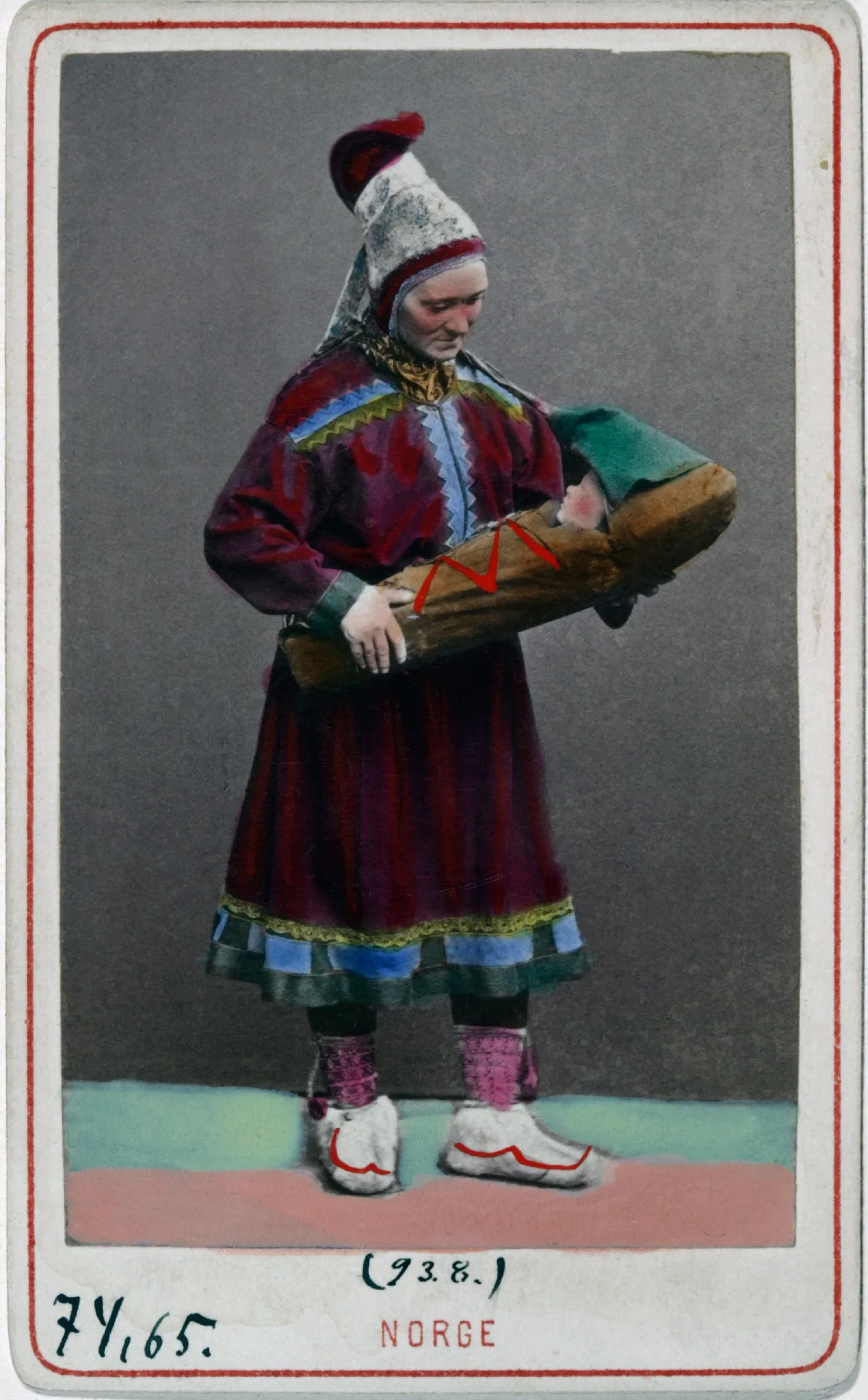
A Sámi woman in Norway with a child in a komse, photographed in a studio in the second half of the 1800s and hand-coloured for sale. Photographer unrecorded. Museovirasto. CC BY 4.0.
The ládjogahpir was worn by Sámi women in what is now northern Norway and Finland from the middle of the eighteenth century to the end of the nineteenth. A fitted cap trimmed in cloth and ribbon, with a curved wooden piece called a fierra set at the back of the head that gave it the profile of a crown. Then it stopped. Within a generation nobody made one, and the skill went with the practice.
The account passed down in Sámi tradition is that priests declared the devil sat in the horn. Researchers more often connect the disappearance to Laestadianism, the revival movement that spread across the north from the 1840s. Its founder, Lars Levi Laestadius, was a Lutheran pastor in Swedish Lapland with a Sámi mother, who preached in Sámi and built the movement around temperance in communities being taken apart by alcohol brought north by traders. It was hard on ornament and display, it spread along the herding routes through lay preachers who were often Sámi themselves, and it came from inside Sámi society rather than being imposed from outside it. Where the hats went is not in doubt. Fifty-eight are known to survive, nearly all in museum stores in the Nordic countries and elsewhere in Europe, four of them in a Berlin cellar alongside 980 other Sámi objects.
Since 2017 the artist Outi Pieski and the archaeologist Eeva-Kristiina Nylander have traced every ládjogahpir they could find, measured and photographed them, and run workshops where Sámi women build new ones from the old patterns. The hat is in use again, roughly a century and a half after the last one was put away.
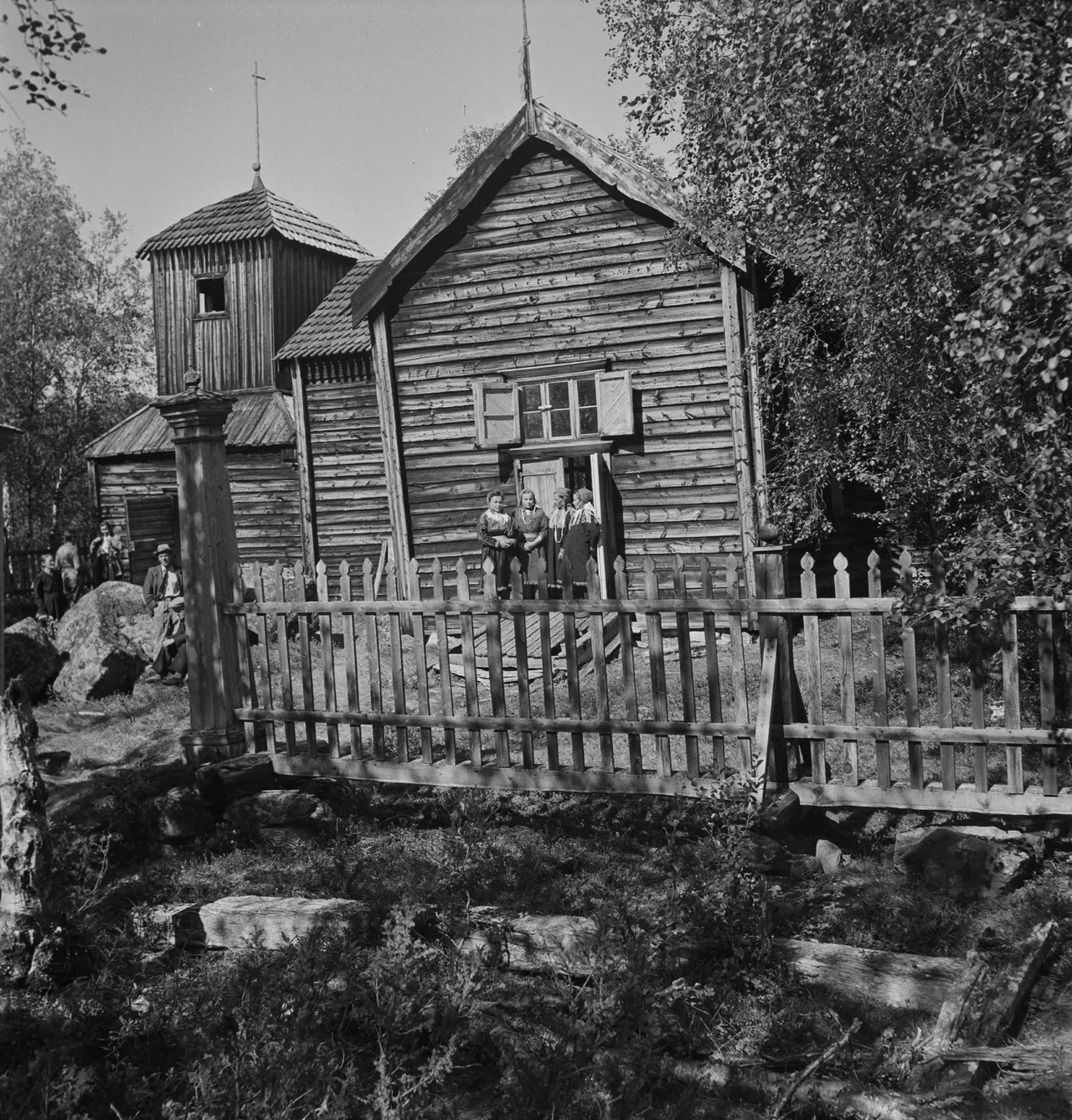
The wilderness church at Pielpajärvi in 1946, with a confirmation class and other churchgoers in the yard and at the door. Uuno Peltoniemi, 1946. Museovirasto. CC BY 4.0.
Five kilometres from the road at Inari, at the end of a path through birch, stands a wooden church finished in 1760, on the spot where the Inari siida spent its winters. It has no graveyard. The dead were rowed out to islands in Lake Inari, where animals could not reach them.
In August 2022 the last Sámi remains held by Finnish institutions were buried again on one of those islands, about 140 people across three sites, with a funeral service. Ninety-five had already been returned to the same island in 1995. They had been taken out of these graves in the same decades the objects were being collected, and they went to the same city.
The islands are burial ground and not a destination. The church stands empty and unlocked, and in July the meadow around it is loud with mosquitoes.

Written by
SightQuests
Editors
SightQuests gathers the places worth a detour: architecture, nature, heritage, and the occasional meal with a past. We write about what caught our eye and kept us thinking. The questing is up to you.