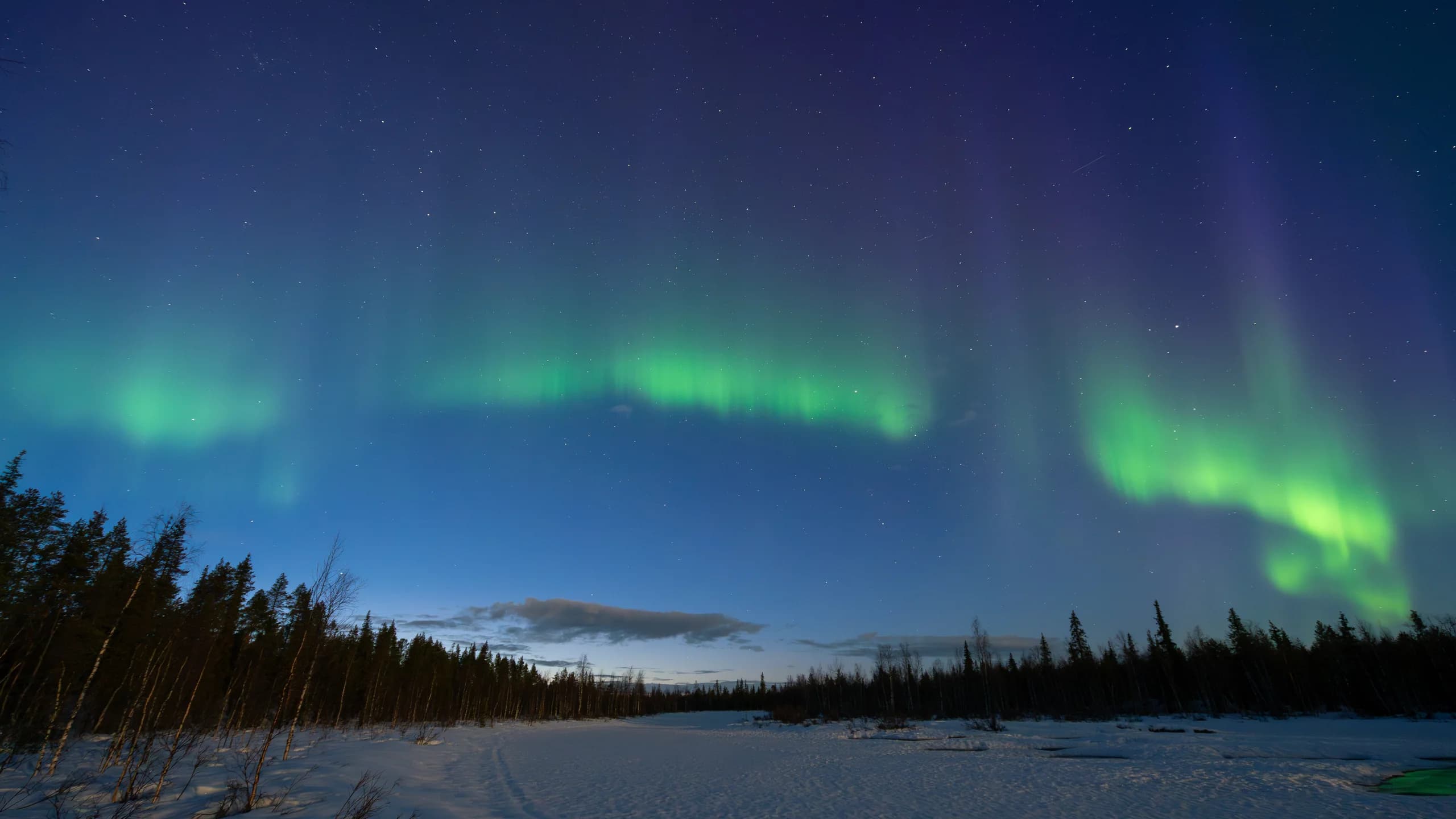
On the fells of northern Finland runs a fox that no hunter has ever caught. It is black by day. Brush the fur the right way and it throws light, and when the fox runs, its tail strikes the snow and the low branches and the sparks fly up and stay there. That is where the Finnish word for the aurora comes from. Revontulet, fox fires, from an old word for fox and the word for fire. Fur really does spark in cold dry air, which is as close to the physics as the tale gets. The light itself forms about 100 kilometres up, a long way beyond the reach of a fox's tail.
On the fells of northern Finland runs a fox that no hunter has ever caught. It is black by day. Brush the fur the right way and it throws light, and when the fox runs, its tail strikes the snow and the low branches and the sparks fly up and stay there. That is where the Finnish word for the aurora comes from. Revontulet, fox fires, from an old word for fox and the word for fire.
Fur really does spark in cold dry air, which is as close to the physics as the tale gets. The light itself forms about 100 kilometres up, a long way beyond the reach of a fox's tail.
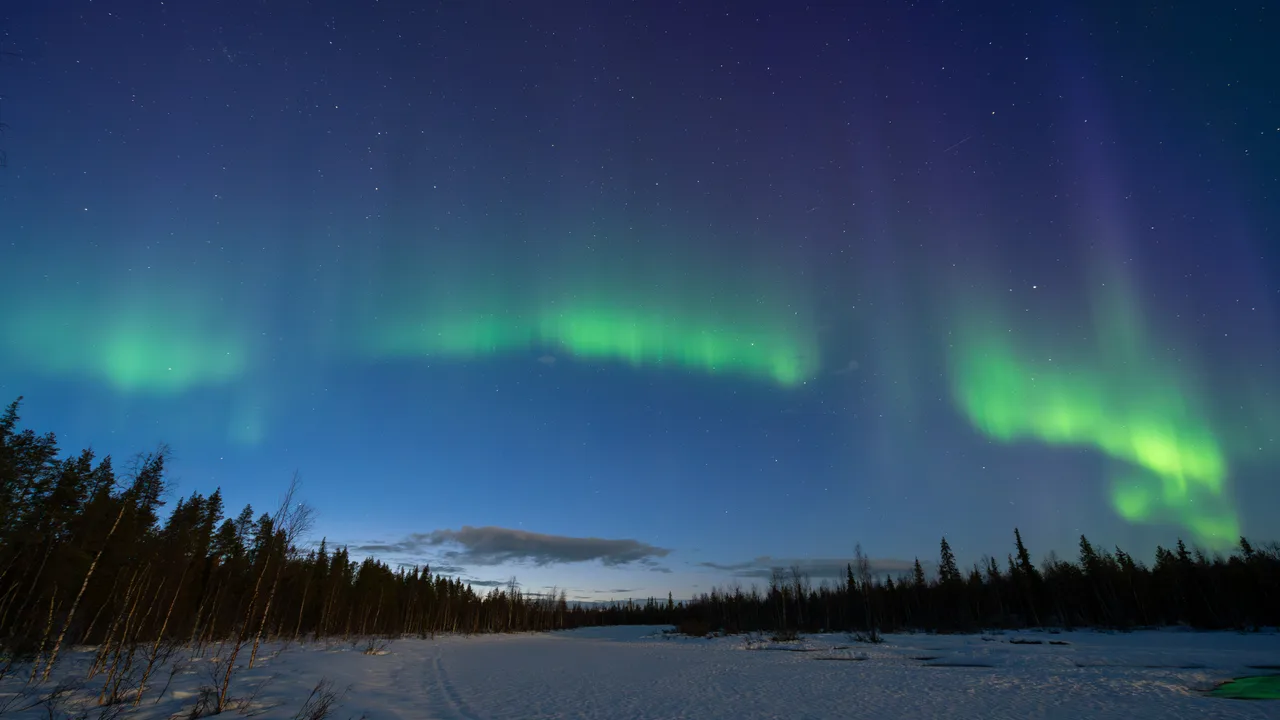
Aurora above Sirkka, Finland. Photo by: SightQuests.
The rule about noise
That is the Finnish explanation. The same sky stands over Sápmi, the country of the Sami, the indigenous people of the European north, whose land runs across the top of Norway, Sweden and Finland and into the Kola Peninsula in Russia, and includes the fells the fox is supposed to cross.
In Sami tradition the lights are the dead, and the dead notice the people below. Whistling is how you call them. A whistle under an aurora brings the lights down nearer, and that is also the danger, because what comes down can take someone back up with it. So people keep quiet when the lights appear. No whistling, no singing, no shouting at the sky, and as little talk about them as possible. Children were sent indoors and told to be quiet. What follows for those who ignore it varies with the region and the teller. Bad luck, illness, being carried up and not coming back.
Not all of it is prohibition. The lights were also held to soften arguments, which made the nights they were out good nights for settling a dispute. Sami drums carry the aurora among their painted figures, put there to draw on its power.
The details differ from region to region. Sápmi is large, its languages differ from one end to the other, and the beliefs vary along with them, so much of what gets repeated now is one simplified version of many. What stays constant is that sound is the channel, in both directions. Some elders still prefer to be indoors during a strong display.
The other name
The Northern Sami word is guovssahasat, commonly translated as the light you can hear. That is probably not what it means. In the Encyclopaedia of Saami Culture, the linguist Eino Koponen derives it from the same stem as guovssu, the general Sami word for morning or evening twilight, alongside the verb guovssahastit, to blaze.
Which puts it in the same company as the Latin. Aurora was the Roman goddess of the dawn, and borealis comes from Boreas, the north wind. Aurora borealis is the dawn of the north, and aurora australis, from Auster, the south wind, is the dawn of the south. Three languages looked at a light in the middle of the night and reached for the word for daybreak.
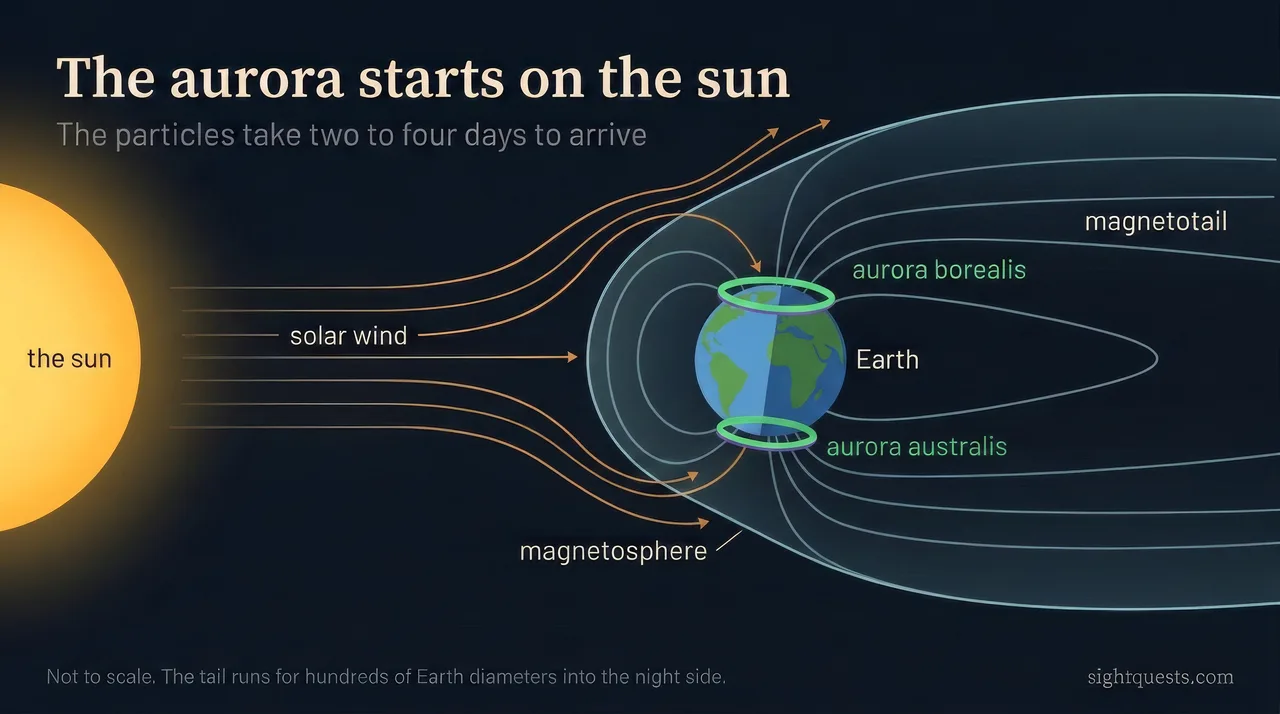
Diagram of the solar wind bending around Earth's magnetic field and entering the atmosphere at both poles. Illustration created with AI.
What the light is
In the winter of 1899 the Norwegian physicist Kristian Birkeland overwintered at about 900 metres on Haldde, a mountain above Alta, in the first observatory built specifically to watch the aurora. His magnetometers moved whenever the light did. From that he concluded that electric currents were running through the sky above him, fed by particles from the sun and steered toward the poles by the earth's magnetic field, and in the laboratory he produced rings of light around the poles of a magnetised globe to show how. Most of his contemporaries filed the idea as fringe, because currents flowing through empty space had no place in the physics of the day. Confirmation came in 1967, from a magnetometer aboard a US Navy satellite, fifty years after his death. The currents are now called Birkeland currents.
Charged particles carried on the solar wind reach the earth's magnetic field, which funnels them toward the poles and lets them fall along the field lines into the upper atmosphere. There they collide with oxygen and nitrogen and knock those atoms into a higher energy state, and the atoms shed the energy again as light. Oxygen gives the green at roughly 100 to 150 kilometres, and a deep red far higher up. Nitrogen gives the blue and violet along the bottom edge of an intense display.
The shapes move for a different reason. The light appears wherever the particles are landing, and where they land is decided by the magnetic field. When the field changes shape, the landing pattern moves with it. During a substorm the field on the night side reconfigures and releases its stored energy, and an arc that has hung still for an hour breaks up in seconds. What crosses the sky is a pattern, not an object.
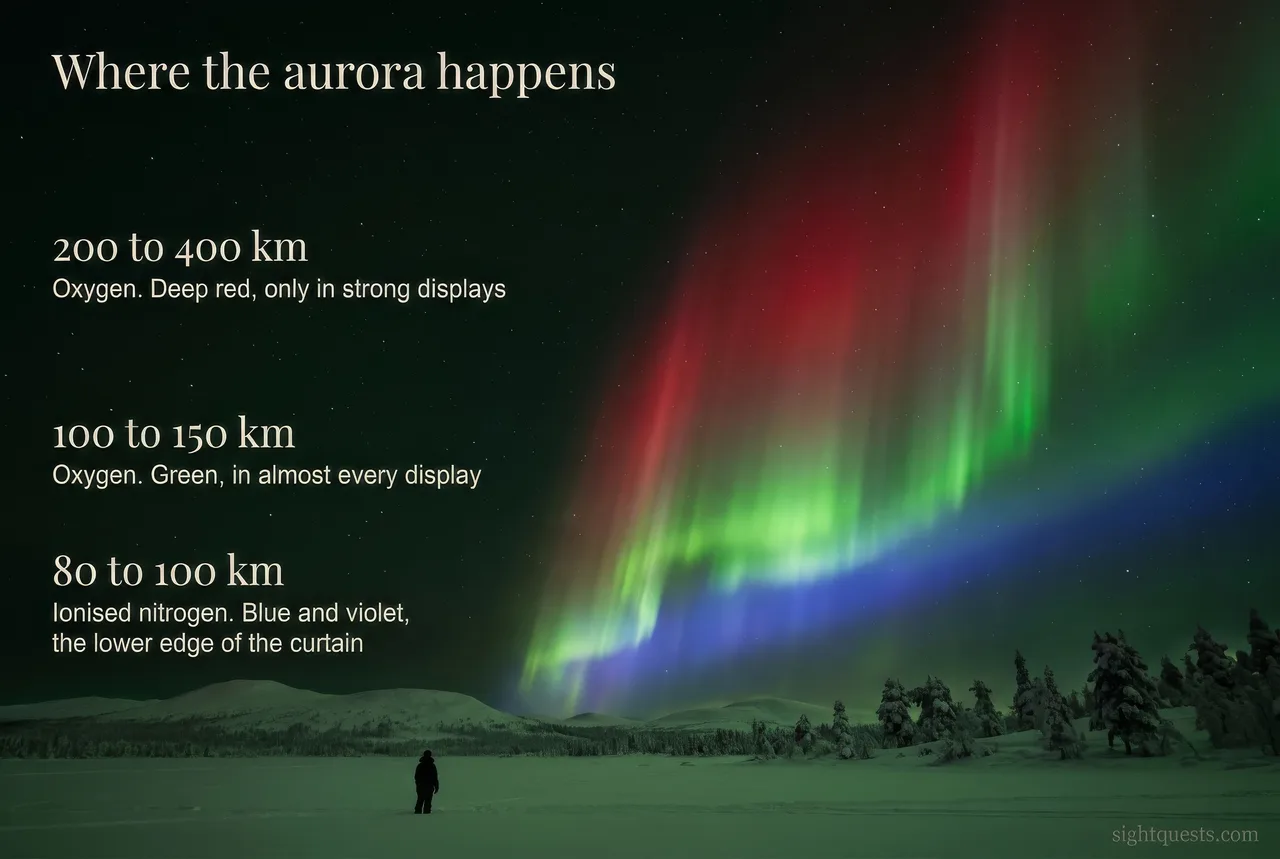
Diagram showing aurora colours by altitude, red oxygen above 200 km, green oxygen at 100 to 150 km, nitrogen blue and violet at 80 to 100 km. Illustration made with AI.
Can you hear the northern lights?
Whether the aurora makes a sound was treated as settled for a century, and the answer was no. Sound needs about five minutes to travel 100 kilometres. People who report a crackle report it at the same moment they see the movement, so it cannot be arriving from up there.
Unto K. Laine, an acoustics researcher at Aalto University, began recording anyway in 2000. By 2011 his group could locate the sources: about 70 metres above the ground, directly over the microphones. On a still, clear night cold air pools near the ground under a warmer layer, and charge builds at the boundary between the two. A geomagnetic storm sets it off, and the discharge crackles.
So the light and the sound are not the same event. They share a trigger. The storm lights the sky at 100 kilometres and, on the right kind of night, sets off a discharge seventy metres above your head. Laine's inversion layer hypothesis is one group's explanation rather than settled physics, which is worth saying plainly.
Where can you see the aurora?
The lights sit in a ring around each magnetic pole, the auroral oval. In the north it crosses Lapland, Iceland, southern Greenland, northern Canada and Alaska, which is why Tromsø, Reykjavík, Yellowknife and Fairbanks appear on every list. In the south the same ring falls mostly over open ocean and Antarctica, with Tasmania, southern New Zealand and the far south of Chile and Argentina along its edge, so far fewer people are in a position to look.
The Finnish Meteorological Institute calls Finland one of the best inhabited regions in the world for watching, and publishes the numbers behind it. On a dark and cloudless night the aurora appears at Kilpisjärvi on about three nights out of four. In central Lapland, around Levi, Ylläs and Saariselkä, on about half of them. Around Oulu and Kuusamo, on about one night in four. In Helsinki, roughly once a month. Inari and Utsjoki sit above the central Lapland figure, Rovaniemi on the Arctic Circle a little below it. On the Norwegian coast at Tromsø the lights are close to nightly, although Atlantic weather takes back much of what the latitude gives.
That last point is what decides most trips. Aurora activity is not the limiting factor in Lapland; darkness and cloud cover are. Inland Lapland is drier than the coast, and the low fell terrain leaves the northern horizon open, which matters because the lights are most often seen low in the north rather than overhead.
The timing is less obvious than it looks. Auroras occur fairly evenly through the year, with a rise around the equinoxes, when the earth's field tilts into a position that couples more efficiently with the solar wind. Midwinter buys the longest nights but not the most activity. Weather included, the FMI puts the best period for northern Finland in March and early April. Within a night, displays cluster around midnight and a couple of hours either side.
Solar cycle 25 peaked in October 2024, so the coming seasons sit in the declining phase. Fewer of the large storms that made 2024 and 2025 unusual, more of the fast solar wind that streams from coronal holes and returns on a 27 day rhythm as the sun turns.
For live conditions in Finland the FMI runs Auroras Now, which flags the moment local magnetic disturbance passes the threshold for a given latitude and carries images from all-sky cameras through the dark season, and its aurora page explains the figures above. Anywhere else, NOAA's thirty minute forecast shows the oval over both hemispheres and is the model most aurora apps are quietly running underneath. On a phone, Aurora Alert Realtime is free and built around Finnish locations, and My Aurora Forecast works anywhere.
The sound is harder to catch than the light. It wants cold, no wind, an inversion overhead, no engine within earshot, and someone standing still long enough. Most reports come from strong displays, and most nights give nothing.
Which is roughly where the old stories left it. One put the source down in the snow, at the height of a fox's tail. The other held that sound crosses the gap between a person and the sky, which is the claim a century of physics denied and a set of microphones eventually recorded. The light is a hundred kilometres up and often several hundred kilometres away, off across the northern horizon. The crackle, when the recordings caught it, came from about seventy metres above the microphones, on a cold still night with nobody making a sound.

Written by
SightQuests
Editors
SightQuests gathers the places worth a detour: architecture, nature, heritage, and the occasional meal with a past. We write about what caught our eye and kept us thinking. The questing is up to you.